AI Logos Aren’t the Problem — The Symbols Behind Them Are
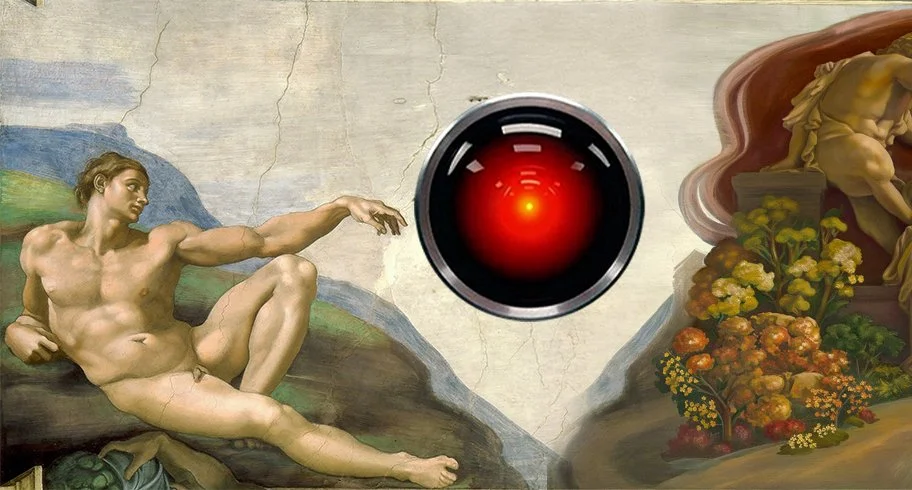
A recent text from my buddy about AI logos looking like a certain body part prompted me to wonder why did AI logos look that way.
For some time now, the internet has been circulating tongue-in-cheek commentary about how many AI company logos look — deliberately or not — like buttholes. The meme is funny because it’s true, and because designers collectively recognize the unintended anatomical resemblance that has somehow become a visual trope in artificial intelligence branding. Usually these kinds of unintended design executions get edited out in the reviewing stage, but somehow, these did not.
But the deeper issue is not the resemblance itself. It is why these logos all converge toward the same shape, the same glow, the same symbolic lineage. Granted trends have lent themselves to mobile first application but nevertheless, it is profoundly surprising that so many have leaned heavily on the same concept. It’s as if the logos themselves were prompt-created rather than deep dive researched and conceptualized. The joke sits on top of a much older visual representation problem: we keep representing AI as if it were the source of intelligence rather than a system built to navigate and structure the intelligence we already have and can input. And that lineage takes us directly back to one of the most influential visual interpretations of machine intelligence ever put on screen.
The HAL 9000 Problem
Before most people could imagine what a machine mind might look like, Stanley Kubrick had already done it for them. The glowing red eye of HAL 9000 in 2001: A Space Odyssey became a cultural shorthand for machine sentience, machine danger, and machine intention. And whether consciously or not, the tech world has been iterating on that image for decades: a circular core, a radiant center, intelligence framed as singularity.
Before that, machine intelligence was depicted as physical, often humanoid robots, or as nonsensical, comedic klutzy robots exclaiming “danger, danger” a-la Robinson family, or overtly villainous machines, larger computer systems churning data with exaggerated wheels spinning, making “computer sounds.” The inherited visual language that Kubrick delivered, positioned AI as the origin of thought — the ignition of new ideas — the brilliant spark at the center of creativity. It is no wonder people fear AI. The design language is telling them that AI is an omniscient, central, radiant consciousness.
The Real Misrepresentation Is Semiotic, Not Anatomical
Most AI branding defaults to a symbol that radiates outward. A spark. A sun. A glowing portal. It is meant to convey inspiration. Almost like thought itself. But inspiration is the wrong metaphor for AI. AI is not a muse. AI is not an origin point. AI is not the ignition of human potential. AI is not the key that unlocks some transcendent future. AI is a tool. Those symbols —vortices, sparks, glowing centers — imply a singularity of meaning. A mythic threshold. A point of divine access. And that is precisely the sort of imagery that heightens cultural anxiety around AI. The fear doesn’t come from the technology. It comes from the fiction we’re using to depict the technology. As machines were during the industrial revolution, as far back as Samuel Butler’s 1863 article “Darwin Among The Machines,” fear noted that humans would become subservient to machines.
AI Isn’t a Spark. It’s Depth.
If we were being more honest, AI would not be symbolized by a glowing center at all. It would look more like a keyhole than a key — an aperture into layered knowledge, not a spark that generates knowledge from nothing. A key suggests ignition. A keyhole suggests potential of what is inside — boundaries, depth, pressure behind the surface.
This distinction matters because AI is not infinite, omniscient, or source-driven. It is bounded, trained, contextual, and useful only within guardrails and human expertise. A spark radiates. A keyhole implies what it contains. The latter is a far more truthful metaphor for machine cognition.
The Surprising Exceptions: Midjourney and DeepSeek
Interestingly, a few companies have shifted away from the HAL-derived visual lineage. Midjourney and DeepSeek, two of the most culturally visible AI products, use imagery that is neither cosmic nor radiant. Instead of abstract eyes, portals, or singularities, they lean on oceanic symbols: a ship at sea, a whale in motion. These are not gradients or vortices, but they still point us toward water — toward navigation, currents, and immersion rather than ignition.
That difference is not merely aesthetic. It is semiotically radical. A ship and a whale frame AI as something you travel through or work with, not a disembodied, all-seeing core you submit to. They suggest environment, depth, and relationship, where the more typical glowing-ring logos suggest singularity, revelation, and central authority.
This shift is not trivial. It represents a meaningful reframing of what AI is supposed to be. Why the ocean? Why not space — our default metaphor for infinity and boundless possibility? Space suggests cold vastness, existential scale, and unreachable infinity. It reinforces the myth that AI is an unbounded, transcendent intelligence.
The ocean, by contrast, is mysterious but bounded. It is deep but terrestrial. It is layered, pressurized, and structured. The ocean is the last frontier within our world, not beyond it. It represents descent rather than ascension, exploration rather than revelation. AI is far more like the ocean than space. It is not a cosmos. It is a pressure system — layered, structured, accessible only through guided descent and human expertise.
The New Semiotics of AI: Depth Over Brilliance
As AI becomes more integrated into daily life, the battleground will not be the technology itself — it will also be the symbols we use to understand it. We do not fear what we understand. We fear what we unknowingly misrepresent.
If we continue depicting AI as a glowing, omniscient source of intelligence, we will continue inheriting HAL’s shadow. But if we shift the metaphor toward contained depth — toward layered understanding and structured exploration — I believe the cultural posture changes.
AI is not the spark. AI is the depth behind the surface.