Part 2: Making Structure Machine-Readable
From “The Social Media Crisis Isn’t About Facts. It’s About Format.”
In Part 1, I argued that the crisis in our feeds is not simply a war over facts. It is a war over format, the way posts blend truth and distortion into seamless narratives that look authoritative regardless of how they are built. We optimized platforms for engagement. We never built infrastructure for structural support.
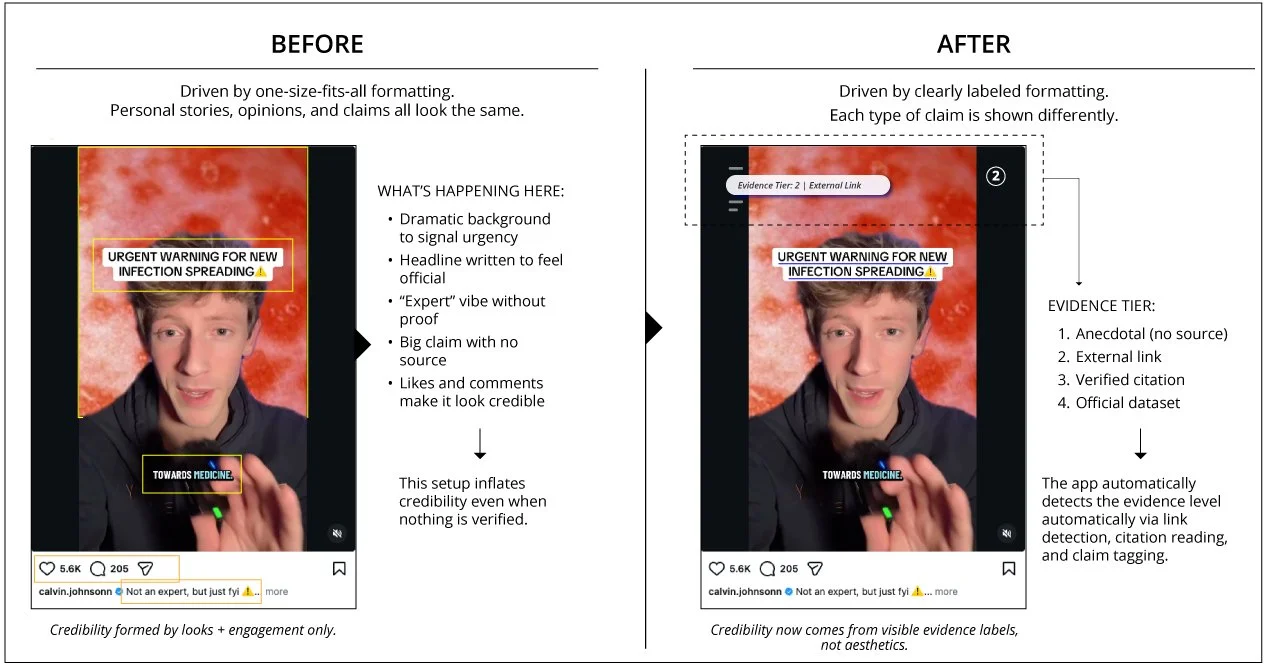
I proposed structural guardrails: visible claims, visible sources, visible corrections, and ranking systems that treat clarity as a quality signal. But that proposal hides a practical problem. Who does the labeling?
If every creator must manually tag every claim, paste every citation, and update every post as evidence shifts, the system collapses at the very point where misinformation thrives: speed and scale. Human discipline cannot carry structural governance.
If structure is going to matter, it cannot depend on effort. It has to become machine-readable, not to decide what is true, but to expose how claims are built.
To make scaffolding visible at scale, we need three layers: Claim Decomposition. Evidence Tiering with Structural Support. And a visible structural surface we might call Trace. A layer that allows readers to see how a post is actually built.
Consider viral prediction clips from Professor Jiang.

Different versions of the same prediction circulate across platforms, compressing a layered argument into a single viral storyline.
Viral Predictions Flattened Into One Narrative
Across these formats, the same argument begins to circulate through different contexts. The clips circulate widely. It feels coherent. Inevitable.
Professor Jiang outlines a geopolitical scenario during a lecture.
The lecture clip circulates within online course material and academic discussion.
Short-form edits extract the most dramatic predictions for social media distribution.
Commentary channels reuse the clip, reframing the scenario as a plausible outcome.
Television panels and online pundits reference the clip as expert analysis.
Reaction channels and meme edits amplify the most extreme conclusions.
Audiences ultimately encounter a compressed storyline:
Trump wins → war with Iran → America loses → economic collapse.
Some of these claims are now resolvable. Some are observable developments. Some are forecasts. Some are rhetorical characterizations.
The clips present them as one continuous line of inevitability.
That flattening is the format problem.
In the process, a layered argument containing different kinds of claims becomes compressed into a single narrative arc.
1. Claim Decomposition: Separating Assertions From Narrative
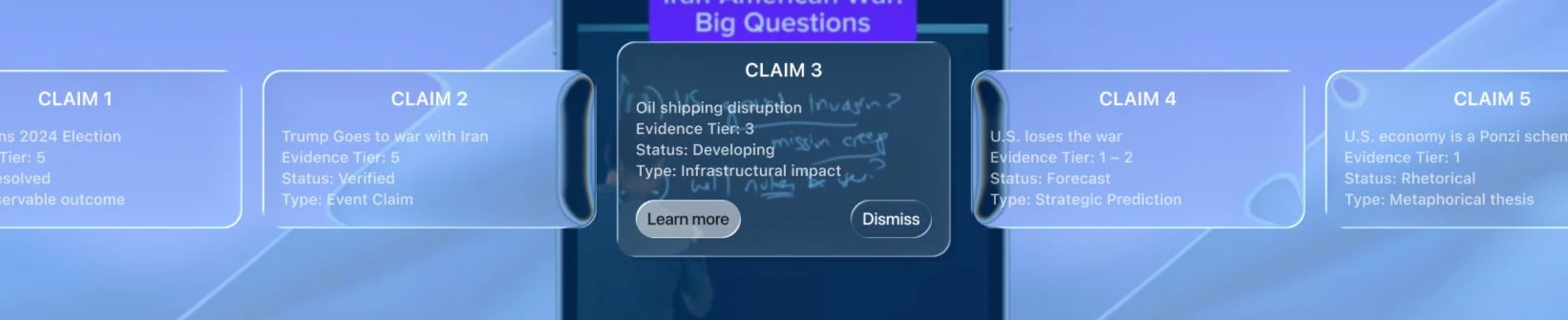
Platforms treat the clip as a single object: one video, one engagement number. A structural system would separate it into evidence units — individual claims that can be evaluated independently.
The eight statements above are not one prophecy. They are distinct epistemic objects. The cadence, tone, and emotional arc are narrative framing layered over assertions.
Decomposition does not censor. It clarifies. It distinguishes between a certified outcome, a developing event, an inference about intent, a forward-looking forecast, and a metaphorical thesis.
That distinction matters because these objects behave differently over time.
2. Evidence Tiering: What Kind of Support Exists?
Not all claims are built the same way. Structural support can be described in tiers:
Tier 1 — Rhetorical or anecdotal framing.
Metaphor, sweeping characterization, personal interpretation.Tier 2 — Referenced but interpretive material.
Commentary or analysis that gestures toward sources without primary documentation.Tier 3 — Documented and checkable claims.
Certified outcomes, official reports, named-source reporting, traceable data.Tier 4 — Structured institutional datasets.
Aggregated and auditable systems of record.Tier 5 — Resolved in domain.
Claims that have reached formal resolution within the relevant evidentiary system.
Applied to Jiang’s clip:
Election result → Tier 5
Entry into conflict → Tier 5
Shipping disruption → Tier 3–4 depending on specificity
Strategic forecasts → Tier 1–2
“Empire collapse” → Tier 1
“Ponzi scheme” → rhetorical → Tier 1
Notice the category shifts:
Observable fact
Intent inference
Forecast
Macro-historical thesis
Metaphor
Same tone. Different structural weight.
Correct predictions increase attention. They don’t make the next prediction more reliable.
Once tiers are assigned, the system can estimate structural support — not truth, not ideology, but how much of a post rests on verifiable scaffolding at a given moment.
And that support must evolve.
Social Media Is Frozen. Reality Is Not.
Social media has replaced portions of real-world interaction — not entirely, but meaningfully. It mimics live conversation. It reacts in real time. It positions itself as the arena where unfolding events are processed collectively.
But structurally, posts are frozen artifacts.
A claim made in March appears identical in October, even if the evidence beneath it has strengthened, weakened, or collapsed.
Reality moves. Posts do not.
If platforms host live discourse about live events, then posts must behave more like living objects. A structural layer that updates over time keeps content aligned with the world it claims to reflect.
Claims mature. Stabilize. Decay.

Trace makes that movement visible.
Engagement tells us what spreads. Structural support tells us what stabilizes. We built infrastructure for the first. We never built it for the second.
The Signal: Trace

This does not require a bureaucratic dashboard. It requires a subtle structural layer that can be revealed when needed.
Most of the work happens behind the seams. AI decomposes claims, evaluates evidentiary support, and tracks stability as events unfold. The interface does not interrupt the post itself. Instead, it exposes a transparent analytical layer that sits above the content.
This layer does not belong to the post itself. It belongs to the platform. Trace functions as a structural lens the platform can apply to any piece of content, revealing how the narrative is constructed without altering the content beneath it.
Call that layer Trace.

The name is intentional. In everyday language, people often ask for “receipts” when they want to see what a claim is built on. But the goal here is not confrontation or call-outs. It is structural visibility. Trace borrows the intuition behind that idea while moving it into a calmer register: the ability to follow the path behind a statement.
Trace operates on a second axis. While the feed moves vertically through content, Trace reveals the horizontal structure of the post — allowing users to move through the scaffolding behind the narrative without interrupting the flow of the feed.
When activated, Trace reveals the structural claims embedded within a piece of content. Claims grouped by type, tier indicators, and contextual links.
The post remains fully visible beneath it. Nothing is removed. But it is no longer epistemically flat.
Ignore Trace and the post behaves as it always has. The reader scrolling at midnight doesn’t need a dashboard. They need a moment of friction — a seam they can pull on if they choose. Trace is that seam. Reveal it and the scaffolding becomes visible. The post begins to behave less like a frozen artifact and more like a living object embedded in time.
3. Ranking by Structure, Not Spectacle
Platforms optimize for engagement because engagement is measurable. Structural support has never been measurable at scale.
Once posts are decomposed and tiered, ranking systems gain new signals.
Fewer claims combined with stronger support and visible correction history generate positive structural weight. Numerous claims resting on low support and high volatility generate distribution friction.
Not removal. Friction.
A simple pause — “This post contains several unresolved forecasts. Share anyway?” — introduces reflective delay. Small pauses change behavior without silencing speech.
If AI is going to shape feeds, it should measure scaffolding rather than drama.
Guardrails
A structural system must be constrained: annotation, not deletion; transparent tier definitions; independent audit access; creator contestability; multiple evidence frameworks rather than a single canonical authority.
Without these guardrails, structural annotation becomes control. With them, AI functions as a scaffolding inspector. It does not decide what may be said. It makes visible how it is built.
From Format to Infrastructure
Part 1 argued that the crisis is not merely about facts. It is about format.
Part 2 sharpens that claim.
If format is the battlefield, infrastructure is the terrain.
Right now, the terrain rewards narratives that borrow the aesthetics of authority without structural weight. AI will not fix that by itself. But AI can change what the system sees.
Claim Decomposition separates narrative from assertion. Evidence Tiering measures structural stability.
Trace makes that stability visible over time.
In that world, a reel like Jiang’s is neither suppressed nor blindly celebrated. It is rendered legible: a mixture of resolved outcomes, documented developments, strategic forecasts, and rhetorical leaps — visible in structure and dynamic in time.
The goal is not to end disagreement.
It is to ensure that structural credibility cannot be counterfeited by format and inference alone.
The pieces exist.
Claim decomposition. Evidence tiering. A structural surface like Trace that makes scaffolding visible without touching the content beneath it. None of this requires technology that doesn’t already exist.
For designers and platform builders, this distinction matters. Interface structure determines how information travels: what is visible, what is amplified, and what is ignored. If the format rewards speed, outrage, and novelty, no amount of fact-checking can correct the systemic bias built into the design.
The harder problem is incentive.
Platforms did not become dominant by slowing narratives down. They became dominant by removing friction and accelerating spread. A system that exposes how narratives are built runs directly against the architecture that made them powerful.
So the question is not whether this could be built.
It is who would build it, and what would have to change before they did.